(Note: I’ve been thinking for a while about blogging more. Especially having worked out it’s just over three years since my first and only post! I’m now writing elsewhere this year, so it’s not for lack of wanting to write. I just keep thinking ‘I could write x or y’ and then having the fear it won’t be long enough, good enough, detailed enough. Solution: just write something and press ‘publish’ whatever the hell it is.)
So. I went to see Aknaten, an opera, at the English National Opera in London last month with my friend Dan. ‘Aknaten’ or ‘Akenaten’ (I use them interchangeably because I can) was an Egyptian pharoah in the 1300s BC and it’s about his story (more on that later). ‘Opera’ is a loose term for the hynoptic, religious, sometimes absurd spectacle that we watched, which either made me lose track of time entirely or had me watching my watch in slight frustration at times.
Also, how it connects to Deus Ex: Human Revolution and Serious Sam (ish).
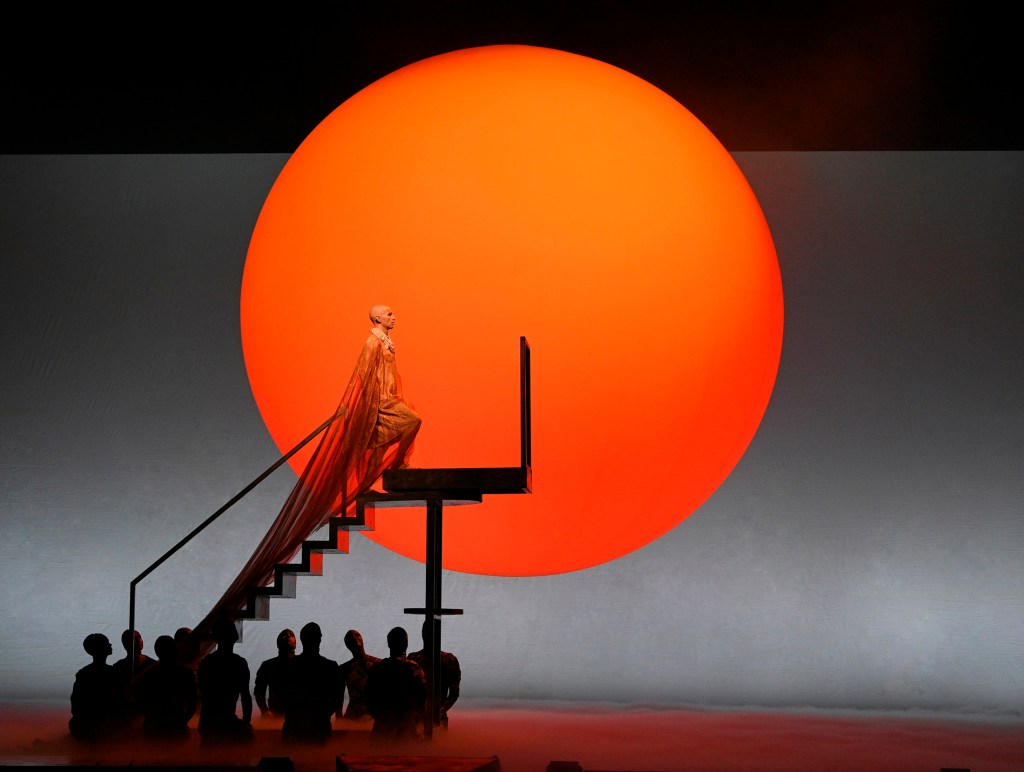
About Akenaten (the person)
Wikipedia summary here. TL;DR –
- When he became king, Egypt was at its height of power; the Great Pyramids at Giza were already a thousand years old (and he in turn was well over a thousand years before the birth of Christ).
- He was husband to Nefertiti and father of/ancestor of Tutankhamun.
- He is chiefly known for abolishing/neutering the ‘classic’ ancient Egyptian pantheon (Amun, Ra, Horus, Anubis, Set, Mut and so forth) and replacing them with the world’s first monotheistic religion – the worship of Aten, the Sun.
- Some scholars attribute the monetheism of Judaism, and in turn Christianity, to Akenaten.
- There is a lot of debate about the kind of person he was, his sexuality and gender, how that is reflected in art at the time.
- We don’t know much really about what happened to him because when he died there was a concerted effort to wipe him from history; his temples were cast down and the blocks used in other temples and statues. But enough remained that we know something of him.
I first heard about Akenaten when I travelled around Egypt in my early twenties, after law school but before my training contract began. I’d seen many temples and heard a lot about ancient Egyptian religion. Then the idea came along quite casually on one day that there was one pharaoh who tried to sweep it all away and replace it with one all-seeing God*, for the first time. Except it didn’t work, he died, his successors tried to wipe him out from history and all his work was all rolled back. Then layered in were the stories of Nefertiti and the famous Tutankhamun (at the time Tutankhaten) later on. You can see how there could be great stories told about it. Sometimes I thought idly about there being an epic historical film about it.
*A useful thing I learned is that he didn’t invent Aten-worship, it had been around for a while, but his father and then Akenaten really expanded it. No one knows how much he actually believed it and how much it helped to expand his power and reduce the power of the priests. No doubt all of the above.
About Aknaten (the opera)
Turns out Philip Glass, a famous opera composer, had the same idea, except he did something about it. Albeit in 1983, when I was just over 1 years old.
Aknaten was a weird, compelling, flawed spectacle.
Here’s the trailer:
Here’s some examples of what it looked like:
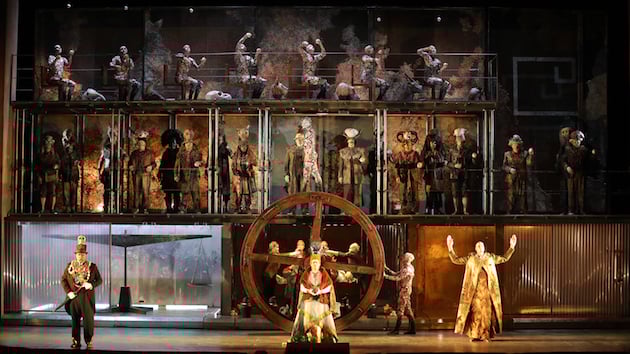
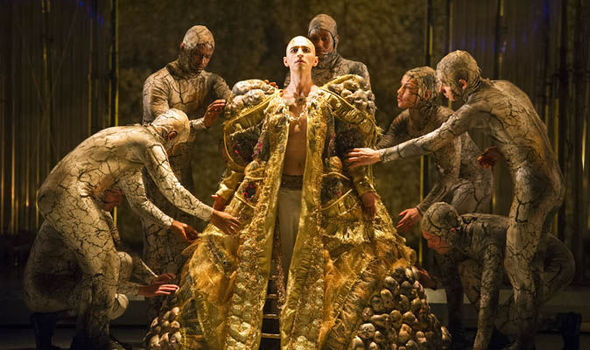
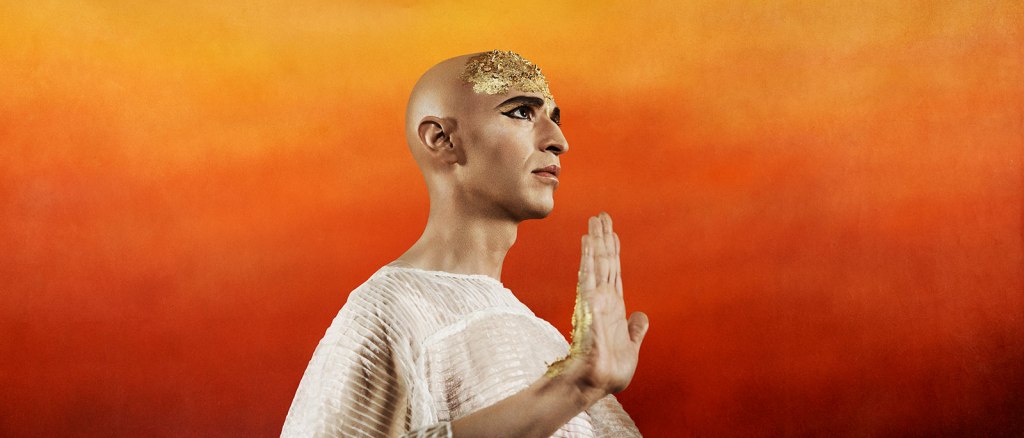
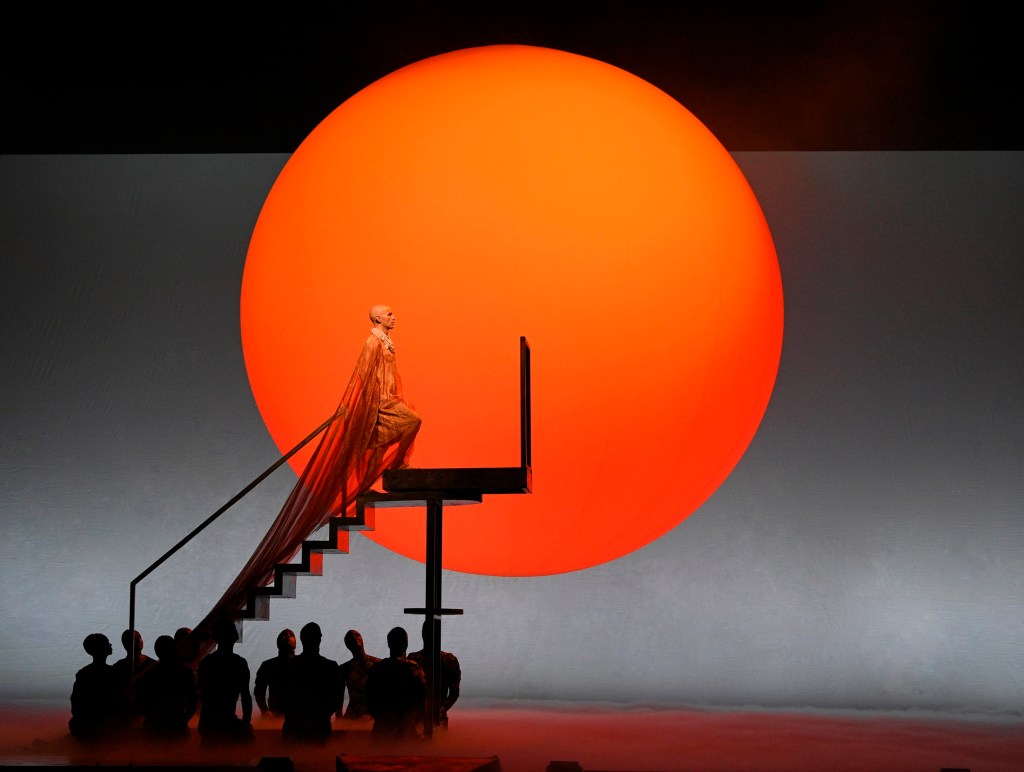

Image credit links 1, 2, 3, 4, 5
This is what Akaten sounds like:
What I thought about the opera
- David Lynch but in the theatre. Not really, but kinda. I watched Twin Peaks series 3 and somehow was lulled into a zone where I could lose track of time and watch a show where objectively so much not only didn’t make sense but was intentionally poking at itself and me, jumping all around the place from the deep (an essence of evil birthing itself with the first atomic blast) to horrifying (“this is the water and this is the well…“) to banal (the damn show made me watch a man sweep a floor for several minutes and somehow be OK with it). In the same way, I could watch Aknaten and suddenly boom the first act was gone, boom the second act has gone too. It was like I had woken up and turned to look fuzzily at my theatre companion, who was looking at me in an equally surprised state. To which world had we somehow been transported without realising it? As my friend said, there was a sensuous to it (the word is apt but makes me uncomfortable, not sure why).
- Eccentric performance art. But the juggling, why was there so much juggling? Juggling from start to finish, juggling so that I thought Aknaten would go flying tripping over all the wandering balls.

- It’s opera Jim, but not as we know it. Big powerful voices, check. Actors standing looking straight at you for minutes at a time while using said voices, check. No idea what they are saying but just listen to their voices and the emotion in it, check. It’s not like I really know opera, but it looked like opera to me. But all these strange aspects to it. The repeating patterns to the music over and over again (check this out and listen to all ~11 minutes, it’s worth it). The strange sense that the protagonist isn’t actually really addressing the audience or anyone else on the stage at any point in the three hour performance really – he’s talking to his God.
- No idea what’s going on half the time. I had little clue what was happening (despite knowing something of the Akenaten story) until I consulted the programme. Then I could see there was a narrative flow to the three acts. Dunno what I would have made of the opera without it, but I imagine I would have got annoyed at not knowing why I was seeing what I was seeing. Maybe I don’t understand opera and this kind of thing is just OK when you see an opera live, maybe there’s a mode of interaction where you can just take what you see at face value and not try to understand how one scene connects to another. I find that hard to believe. Yet at the same time it’s not like the production cared whether I was confused or not. It’s like the opera equivalent of ‘if you read the game lore buried in [the arse-end of the game] then actually it’s a really rich game’. Well yeah sure, but isn’t that just lazy, or at least you’re focusing on the wrong things?
- But I’m not really sure what the message was? Similar theme to above really. There clearly were themes buried in there sometimes. Akenaten loved his wife and seemed really close to his mum too (hmm). Akenaten as an androgynous character. Conflict between Akenaten and the old priests. But it was all so fuzzy. I only got a sense of them by thinking quite hard afterwards or just reading the programme so that the theatre company could tell me what they had wanted to convey. It was spectacle that you just listened to and watched and enjoyed and went ‘ok, that was that’. I suppose the biggest point for me really is that they wanted to show Akenaten as this radical turning point in history but none of that came across at all really. I don’t think I have the tools to parse this or how to suggest they could do it better. But I know I came away unsatisfied. The thing that troubles me though is that maybe I was looking for something that wasn’t there and I’m missing what was there. I wanted theatre and I got opera.
And yet. It held my attention enough that I went home and listened to it all again on Spotify. And bought another book about Akenaten. And I’m writing this. And I’m still thinking of individual little scenes at strange times of the day. It’s done something to me to sink into my world like this. Despite the jugglers.
I’m still thinking about this. I guess, parvenu latecomer novice naif that I am, I think about this stuff from a perspective of structure, narrative, character. That’s what I enjoy and cleave towards. But Aknaten isn’t about that, it wanted to have just enough of that to hold up the raw visual and audio experience in front of me and the feelings it generated.
Update 19/04/23: my thinking has been changing since I actually published this post, which in turn made me listen more to the soundtrack. Especially to the one below (“Hymn to the Sun”), to which I keep returning. The more I listen to it, the less I worry about things like plot and characters, instead I just let it wash over me and find more nuances each time. Plus each time it makes me wish I understood this/opera/music better.
Akenaten and Deus Ex
I had some idle fun on the train home thinking about the video game Deus Ex (Deus Ex: Mankind Divided to be precise).
Deus Ex is a game about artificial intelligence, augmented/non-augmented humans and what it means to be ‘alive’ and ‘human’. The protagonist, Adam Jensen, goes from non-augmented to augmented (somewhat against his will if I remember correctly) and has a recurring dream/nightmare about being Icarus, the man who gained wings and flew too high before crashing to earth. He later saves or destroys the world, depending on your/his decisions.
I was thinking in particular of this though:

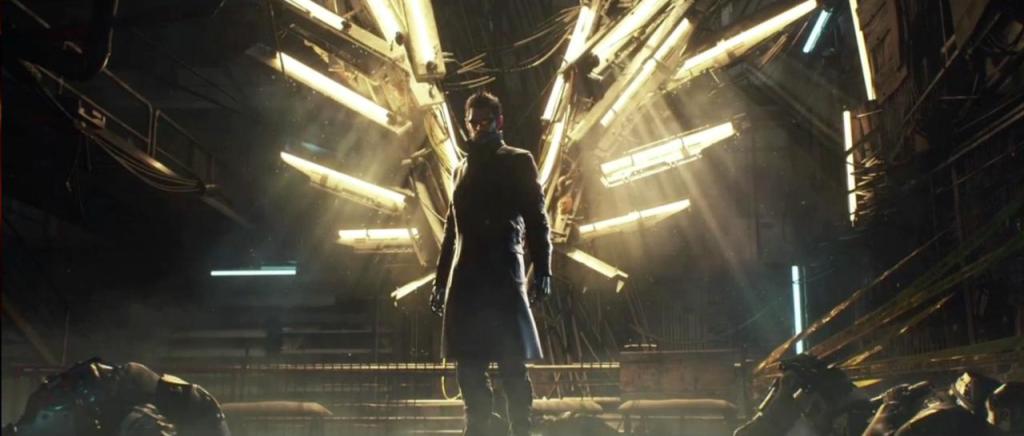
I know it doesn’t come across very well at all from the images but let me have a stab in prose:
- In Aknaten there is a sequence in which chorus characters enter holding staffs that become neon tubes which they position in such a way that when the pharoah stands in front of them he appears to have beams of light, or sunrays, or wings, emerging from/around him. They were quite striking and beautiful and the image above doesn’t do them justice.
- In Deus Ex, there is a part of the game (a slum I think) where some neon lights form a kind of wingshape, eerily reminiscent of the Icarus dream. It’s one of the most striking things I’ve ever seen in a game.
I mention all of this because it made me think (still idle) thoughts about story archetypes going back and back through human history. As time goes by, and I grow more interested in storytelling myself, I become more fascinated by our ‘core stories’ as humans, where they spring up in history and how they changed over time.
Drawing the obvious point together now: Akenaten was Icarus. He gained wings through his belief in an all-powerful singular god, which his resources and his will imposed on everyone else. But it wasn’t stable, it wasn’t meant to be, maybe in the story it was against the natural order of things, so he crashed down to earth. Like in the story of Icarus, there is both the work of the gods at play as well as human hubris. In both stories, there is pathos – we feel sad for them even though we can see why they failed.
Side-reflection on the accidents of history: Akenaten came before Icarus, yet the Icarus myth is the one that persists in the West.
Anyway. I like video games and so I thought I’d make this point.
Akenaten and Serious Sam
This is such a daft point I hesitate to write it now, but I said I would and I’m trying to follow my inner voice now even if says do what seem to be silly things.
Serious Sam is a fun but silly game about a time-travelling dude who goes around the ancient world smacking around bad aliens because reasons. I’ve played each game in the series since I was about 17.
This is Serious Sam in Egypt:
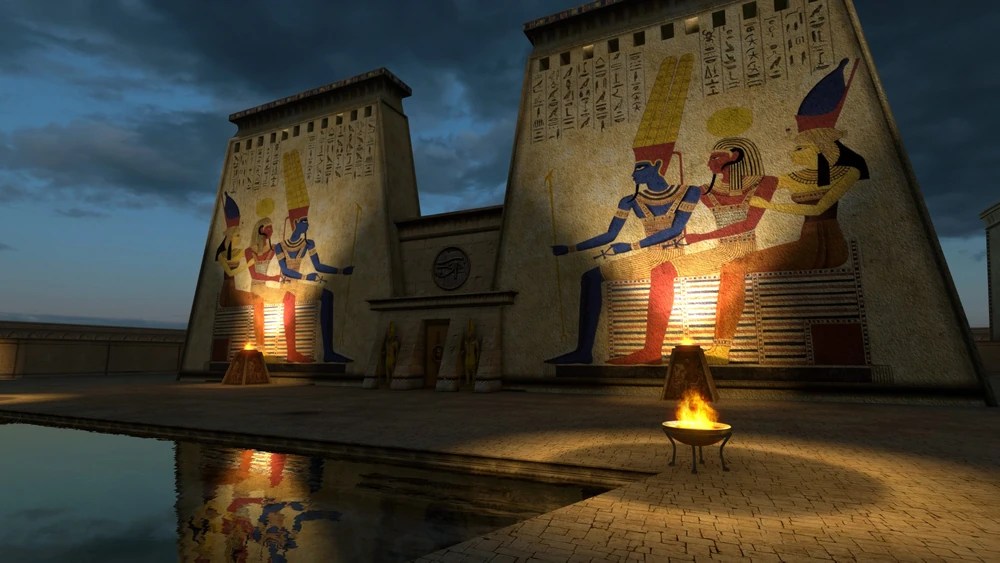

Sorry, I don’t really have any deep points about Aknaten and Serious Sam. Other than to say that, look, ancient Egyptian depictions in Western culture go through the full gamut don’t they.
Actually. Hang on. Here’s something: Aknaten the opera couldn’t sustain itself just with symbolism and stagecraft and the actual opera singing stuff. So they had to put in dancing dudes and jugglers and somewhat clang-y English language sections. It’s silly at times, basically. Serious Sam showed ancient Egypt in quite impressive detail for its time, you could easily just stand there admiring the architecture and the art, but it’s not a simulator, it’s a shooter, so ofc all the silliness. I know, the links are tenuous, but there’s something there maybe? Maybe not.

 Jas writes stuff

I enjoyed reading this, Jas, and am still listening to the 11 minutes of overture in the background! It made me want to go and see the opera in order to form my own opinion, even though I think I might well hate it …
LikeLike